
Aromantics Assemble!
It's Aromantic Week - but what is Aromanticism?

Hello friends - and hoping you all had a lovely Valentines Day (or Galentines, or whatever suits you!) Admittedly, as an aroace (more below, if you have no idea what that means) Valentines Day was a source of confusion and angst in my younger years - these days, I take it more in stride and wait to strike at the discounted, leftover sweet treats on sale.
But I didn’t learn that Valentines Day - always February 14th - precedes a holiday just for me until a few years ago. That holiday - rather, week of celebration - is Aromantic Week! Yes, dear friends - Aromantic Week on the LGBTQIA+ calendar of celebrations begins the day after Valentines Day and continues for one week afterwards.

But what is Aromantic (or Aro) week? Actually, what does “aromantic” mean at all? As a card-carrying aroace (aromantic asexual) I am pleased to bring you the answer to all your queries.
(Not) Shot Through The Heart
For the uninitiated, a few basic definitions are in order:
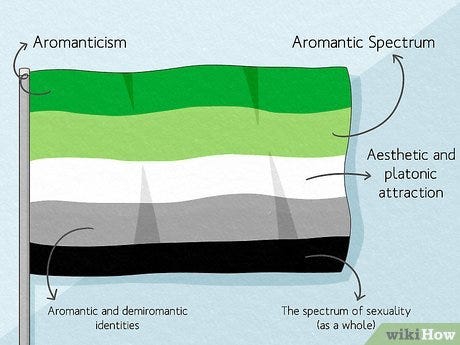
Aromanticism is an umbrella identity typically seen as part of the “A” labels in “LGBTQIA+”. Other labels under the A include asexual, agender, and abrosexual (note that there is not one set list of identities, hence why the plus sign often shows up at the end of the longform acronym).
Michael Paramo, the founder of AZE Magazine, describes asexuality and aromanticism (along with agender) as the “experiences of ‘absence’ that are shared by asexual, aromantic and agender people against the norms and expectations of cisheteropatriarchy.”

Accordingly, aromanticism, like asexuality, refers to a lack of attraction – in this case, a lack of romantic attraction to others. Aromantics can identify using a number of “micro” labels, such as gray-romantic (for those who experience some but very little romantic attraction), demi-romantic (for those who only experience romantic attraction after an intensive personal or emotional bond has been developed) and aroace (someone who is both asexual and aromantic) among dozens of known and oft-changing labels.
Both historically and temperamentally, asexuality and aromanticism are closely intertwined identities. Although a significant number of asexuals also identify as aromantic, the identities are wholly separate. An asexual person can (and often does) experience romantic attraction: examples of this can include people who seek “conventional” partnerships with romantic hallmarks but do not wish to engage sexually with their romantic partner (or do so in specific, carefully defined circumstances).
By the same token, an aromantic person is not necessarily also asexual. Aromantics can and do experience sexual attraction to others, and can have a host of other identities (e.g., lesbian, pansexual).
The key difference is that they lack romantic attraction, or the feelings and mindset which most people within and outside the queer community associate with “falling in love” or pursuing romantic partnership. This “split-screen” in identities (as in, people who are “aro” but not “ace” or vice versa is often called the “Split Attraction Model”.
To break down the differences using historical, and outdated, terminology, asexual people in the past might have been thought of as “cold-blooded” whereas aromantic people might have been categorized as “cold-hearted”.
Amatonormativity
Have you been to any pharmacy or big box store lately? Notice the truly aggressive color coding, the heart-shaped boxes everywhere, the seemingly endless ads begging you to buy chocolate/cakes/diamonds/a linebacker-sized teddy bear for your sweetheart lest they go unloved?

Just as asexuality defines itself as opposite of “allonormativity” (or the assumed experience of sexual attraction in other identities), aromanticism is opposite of “amatonormativity” (the assumed experience of romantic attraction).
Amatonormativity (and all the stuff that goes with it, especially in and around Valentines Day) is something that aromantic people experience on both a societal level and on a personal level. For many of us, this can look like any of the following conversations:
“Why don’t you want to date?”
“I bet someone would want to marry you if you just cared more.”
“You’ve never had a boyfriend/girlfriend?”
“Aren’t you scared of dying alone one day?”
“Everybody needs to feel loved!”
And on and on and on, all compounded by the relentless, commercially and politically driven pressure (especially on aromantic women) to settle us within conventional, easy-to-market romantic relationships.
An important point I would make here, too, is that aromantic people can and do feel love; in fact, for many of us, our lack of romantic relationships often makes our other personal and platonic relationships all the more important to us. Accordingly, we invest heavily in them and treat them with upmost seriousness.
It’s Our Week!
But why have a whole Aromantic Week?
Hopefully, those definitions and explanations help clarify why, yes, it is worthwhile to have an Aromantic Week, but I would offer a few more reasons:
To raise awareness both within and outside the queer community about our labels and identities under the Aromantic umbrella
To explain why aromanticism is queer, and why it absolutely belongs under the queer banner and needs representation in media, books, etc.
To help aromantics identify and better understand themselves (since a staggeringly low percentage of people even know the meaning of the term)
To give aromantics the tools and resources to better explain who they are to others, and form connections with others in their own community
Among many, many more reasons that could be mentioned here. As a note, I have personally done research on the History of Aromanticism, which I am sure I’ll be sharing more in bits and pieces on this blog in the coming months.
Until then, hug an aromantic this week! Or maybe not - we may not be huggers.
As always, thanks for reading!