
Trans+ Goddesses
To celebrate Transgender Day of Visibility, let's explore three ancient deities of gender transformation

As March winds to a close, Transgender Day of Visibility (TDOV) is fast upon us! March 31st of every year marks the celebration of trans+ identities, awareness of transgender history and stories, and recognition of the contributions of the trans+ community.
As this special holiday approaches, I wanted to offer a different - more divine, dare I say? - approach to TDOV this year.
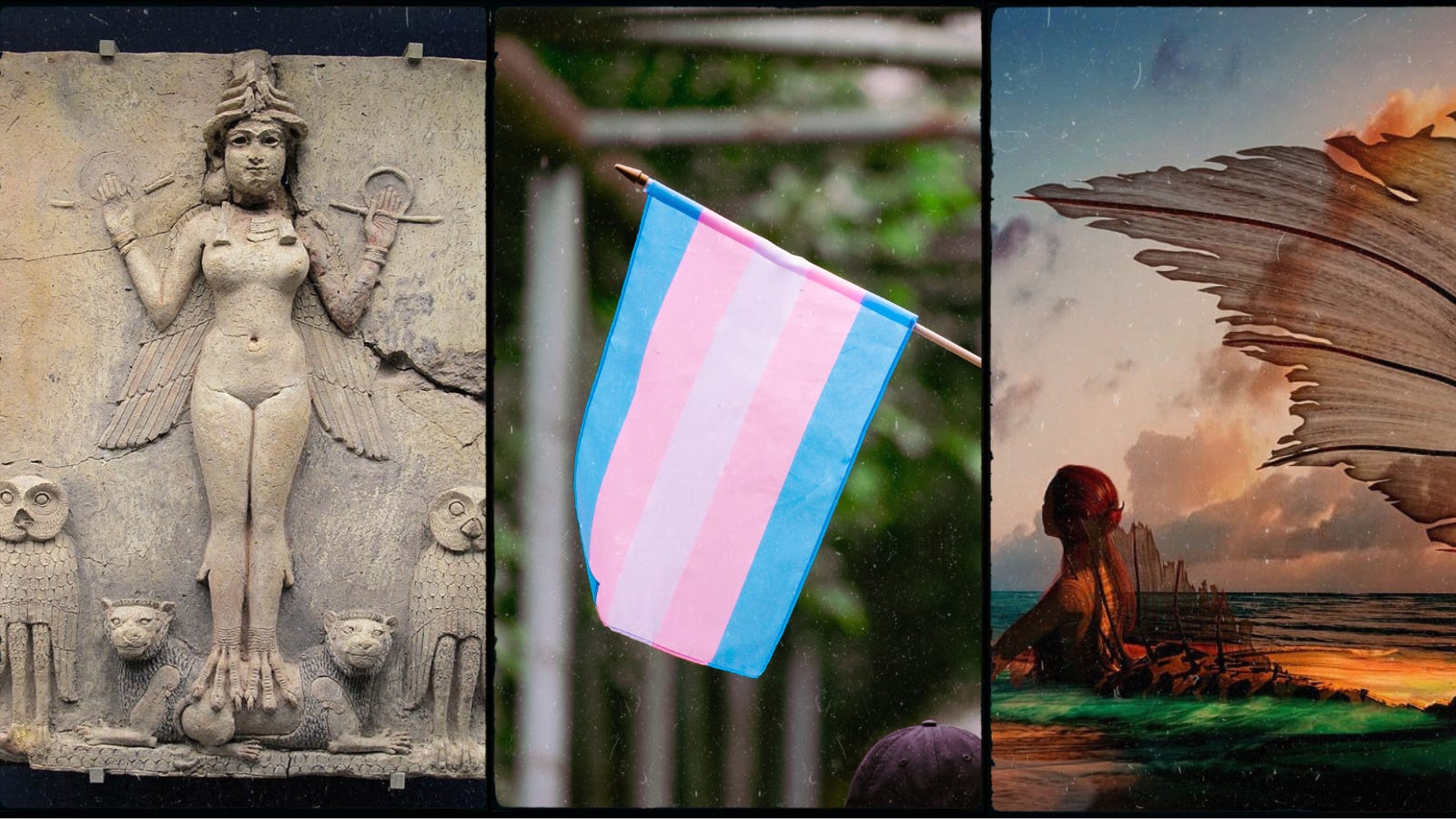
A fascinating aspect of queer history is its intersection with faith, spirituality and mythology. Our belief systems are often reflections of ourselves: our geographies, our cultures, our struggles and aspirations. Little wonder that the celebration of queerness is replete throughout global mythologies – perhaps especially trans+ identities. So what does history say about transgender goddesses, and deities who specialized in gender transition?
This post describes three goddesses famous in the ancient world not only for their beauty and prowess, but also their special relationships with the transgender community.
Ishtar: The Bearded Goddess of Love and War
The goddess Ishtar (also known as Inanna) survives to us from the cradle of Western civilization: Mesopotamia. Her (earthly) religious cult suggests that ancient peoples not only acknowledged trans and genderfluid identities, but exalted them.
Ishtar was worshiped as the goddess of love, fertility, abundance and warfare: “she is responsible for all life, but she is never a Mother goddess. As the goddess of war, she is often shown winged and bearing arms…she is the planet Venus, the morning and evening star.”[2]
Across artistic representations, Ishtar represents multiple genders. Rivkah Harris writes that Ishtar “confounded and confused normative categories and boundaries” in Mesopotamian society because she is “both male and female” with both masculine and feminine traits.[3] Although Mesopotamian worshippers seem to have primarily regarded her as female, she is also famous as the “bearded goddess” of unslakable courage and bloodthirstiness.[4]
But Ishtar was not only personally defiant of the gender binary; indeed, blowing up said binary for mere mortals was her personal specialty. R.B. Parkinson notes that in Mesopotamian lore “[Ishtar] had the power to assign gender identity.”[5]
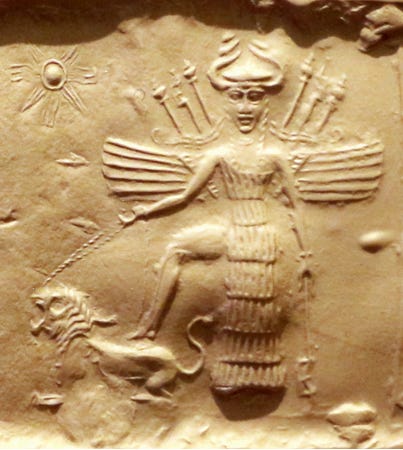
One infamous source comes from Enheduanna, Ishtar’s High Priestess in the city of Ur, and arguably the first recorded author in human history. Enheduanna wrote regularly of her devotion to her chosen goddess, crediting her with almighty powers of transformation of the earth, weather, governments and people. She writes in one such poem, “To turn a man into a woman and a woman into a man are yours, Inana.”[6]
The earliest such worshippers of Ishtar’s first incarnation, Inanna, were called the gala. Roscoe suggests that these were Sumerian priests, mostly assigned male at birth, who entered Inanna’s cult to live as women and perform ritual singing (a task exclusive to women) in a Sumerian dialect eme-sal used only by female deities. These priests took on female names, may have been socially perceived as female, and may have undertaken sexual activities amongst themselves.[8]
Other categories of the goddess’s worshippers were the assinnu and the kugarra; both groups feature prominently in Ishtar’s mythology, such as her fabled Descent Into the Underworld.[9] Both assinnu and kugarra were reputed to be cross-dressers, and some may have deliberately dressed half of their bodies in feminine attire with the other half in masculine attire.[10] As described in one poem:
“Their right side they adorn with women’s clothing, their left side they cover with men’s clothing.”[11]
The kugarra are described in one surviving poem as those “[w]hose masculinity Ishtar has turned into femininity to make the people reverend.”[12] Historians emphasize that this description could represent physical castration (as a bodily representation of gender transformation), a public perception of changed gender, or both.[13]
Isis: History’s Fastest Transition?
Like Ishtar, the goddess Isis was revered by multiple civilizations spanning thousands of years; her cultic centers lasted well into the current era and the establishment of Christianity in the West. Her very name evidences this historical trajectory: Isis is a Greek name, given to this formerly Egyptian goddess (known as Aset in her homeland) when she swelled in popularity throughout the Hellenistic era.
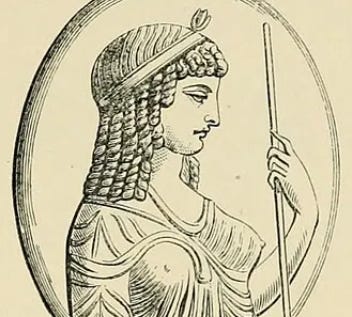
She was a goddess of healing and magic, and a special protector of women.[15] Unlike her more chaotic Mesopotamian counterpart, Isis is portrayed as merciful, generous and compassionate - an immortal that might be called upon in desperation.
Such is the situation in the primary myth where Isis emerges as a champion for a young transgender man, and completes his medical transition with astonishing speed. This fantastical story survives to us in its most famous iteration through the Roman poet Ovid – an author so controversial that he died in exile.[16]
The story begins with the birth of Iphis – a girl (AFAB, perhaps?) whose mother Telethusa hides her gender at birth from her stridently misogynistic father. Iphis is thus raised as a boy and grows into masculinity without a hitch – even earning the adoration of the similarly teenaged Ianthe, a maiden of surpassing beauty. When their fathers subsequently arrange a marriage, Iphis (knowing her assigned gender) descends into panic:
“But Iphis is in love without one hope of passion’s ecstasy, the thought of which only increased her flame; and she a girl is burnt with passion for another girl! She hardly can hold back her tears, and says: ‘O what will be the awful dreaded end, with such a monstrous love compelling me?’”
Iphis, distraught with both love and fear, begs the gods to be spared such a cruel fate of perpetual longing. Her mother, Telethusa, understands Iphis’s crisis. She delays the wedding long enough that they might pray together in a nearby temple, dedicated to Isis, for a miracle from on high.
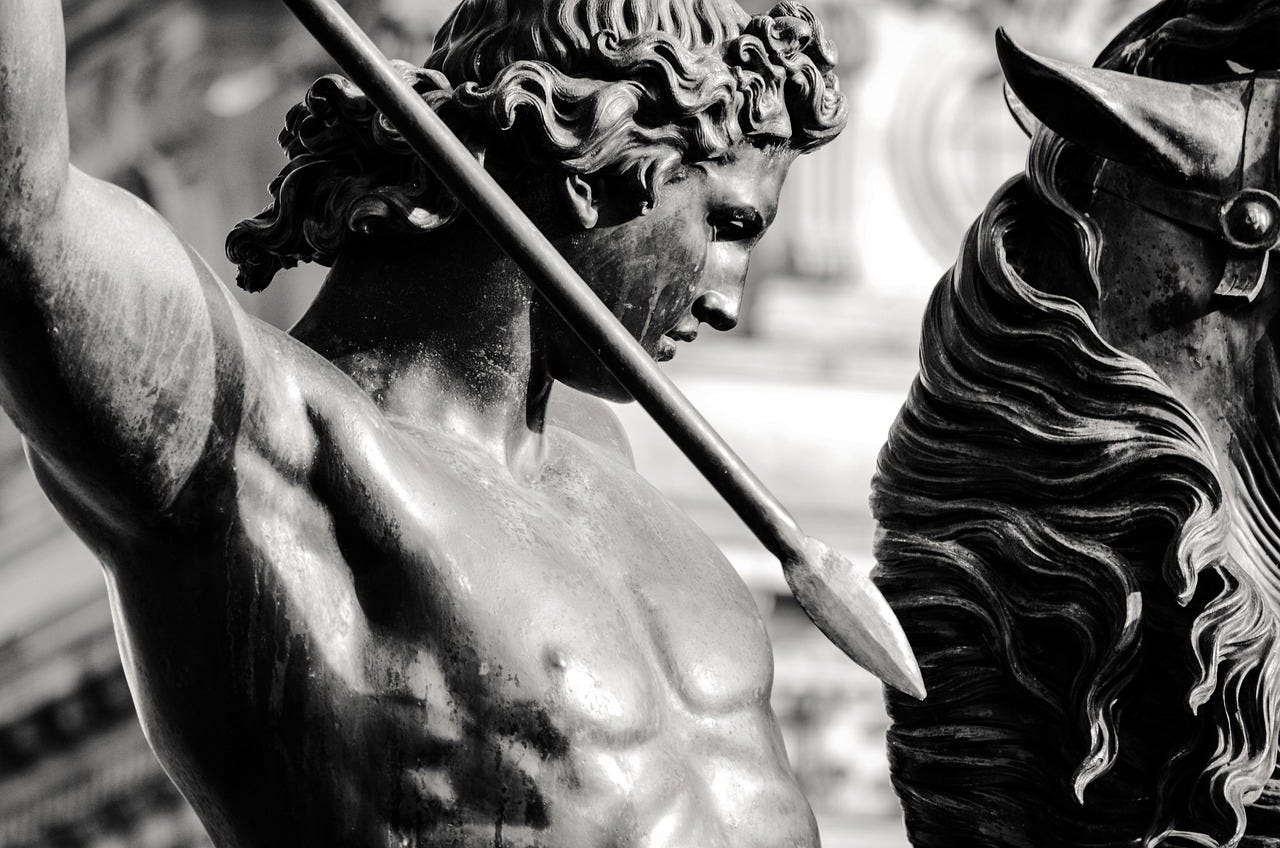
Telethusa and Iphis experience a sudden burst of the goddess’s might throughout the temple: shaking doors, a quaking altar, beams of light surrounding them. Once stillness returns, the pair leave together – but Telethusa quickly realizes that her daughter has been changed.
“Her face seemed of a darker hue, her strength seemed greater, and her features were more stern. Her hair once long, was unadorned and short. There is more vigor in her than she showed in her girl ways. For in the name of truth, Iphis, who was a girl, is now a man!”
The miracle achieved, a jubilant Iphis weds his beautiful Ianthe – and so ends one of Ovid’s most infamous stories.
Given the plain text, is Iphis best understood as a transgender man? Certainly, Iphis seems to have no challenges being raised as a boy, and is by all appearances happy and contented with being perceived as such. The external world (including his own mother and father) perceives and interacts with Iphis as a male, to everyone’s apparent consent and satisfaction.
In this perspective, his “identity crisis” only comes about when the prospect of sexual incompatibility is raised by the imminent marriage. These clues could be used to infer that Iphis is simply an assigned female at birth transgender youth, pleased to have grown up as a boy and delighted to ultimately “become” a man in every other way.
If Iphis is indeed a transgender man, then the central issue in this narrative is if Iphis can achieve his desired gender transition - which he does, all thanks to a powerful and merciful goddess.
Atargatis: The Mermaid Goddess of Trans+ Devotees
Finally, I end this tour through the pantheon of gender goddesses with the most mysterious and elusive lady on the list: the “Mermaid Goddess” Atargatis.
Like Ishtar, Atargatis was reputed to preside over a cult devoted to gender transformation. In her case, this devotion was not just theoretical or mystical, but evidenced in physical acts of worship which made her infamous throughout the Greco-Roman and Hellenistic world.

Her worship dates back at least to the 4th century BCE in her home region of Syria (though her actual veneration may date earlier).[20] Outside of Syria, Atargatis went by many names. For the Greeks and Romans, she was simply “the Syrian goddess” or “Dea Syria”.[21] Another name, primarily used by Roman contemporaries, was “Derceto” which was, according to scholars, linguistically comparable to Atargatis in the languages of that region.[22]
Atargatis bore a range of origins and associations, and may have been the inspiration for later Greco-Roman goddesses such as Artemis/Diana and Aphrodite/Venus. As a goddess of love and fertility, she has also been confused (or perhaps mixed) with Ishtar.
What seems unique about Atargatis, apart from her maternal attributes, are her marine ones. Atargatis is often called the “mermaid goddess” because her iconography regularly depicts a deity that is half woman, half fish.[23]
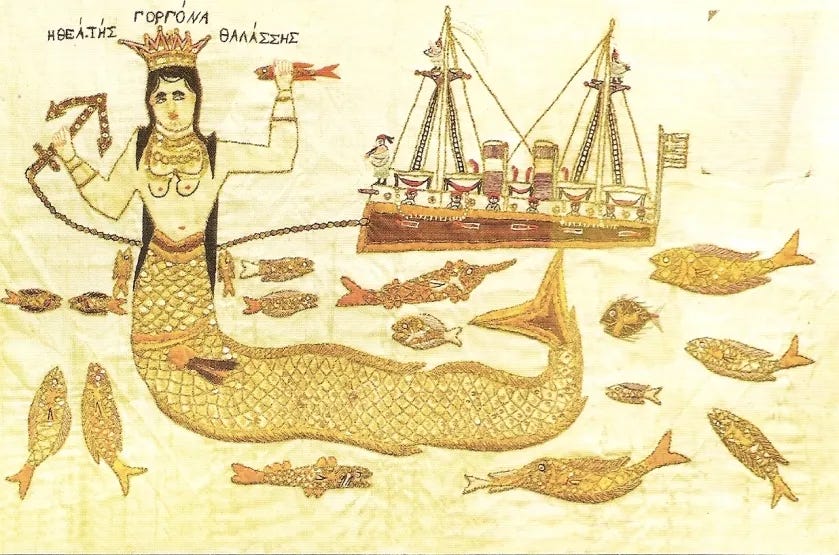
Atargatis, then, was a uniquely dynamic deity with fluid, diverse presentations across the cultural and civilizational fault lines of the Hellenistic world. Accordingly, her cult – her priesthood – was famous for how it starkly reflected the endlessly reinvented, transformational “mother”.
A crucial account comes from the Roman observer Lucian, who traveled to “the Sacred City” of Syria, which scholars argue was Hierapolis, and thence to the temple of Derceto or Atargatis. Lucian, like his contemporaries, endeavors to connect the unfamiliar Syrian goddess with a few that he already knew well: Rhea, Hera, Artemis and Aphrodite, among others.[26] But it is what he describes in his account – a form of ritualistic self-castration – that is especially fascinating.
“[T]he custom once adopted remains even to-day, and many persons every year castrate themselves and lose their virile powers…They certainly castrate themselves, and then cease to wear man’s garb; they don women’s raiment and perform women’s tasks.”[27]
Lucian specifically refers to the castrated priesthood as galli. He suggests that men who wish to join the cult of Atargatis did so willingly, and were active participants in their own “unmanning”:
“Any young man who has resolved on this action, strips off his clothes, and with a loud shout bursts into the midst of the crowd, and picks up a sword from a number of swords which I suppose have been kept ready for many years for this purpose. He takes it and castrates himself and then runs wild through the city, bearing in his hands what he has cut off. He casts it into any house at will, and from this house he receives women’s raiment and ornaments.”[28]
Once completed, these individuals transitioned to serving, dressing and behaving as women for the remainder of their lives.
Even more intriguing is that this practice was apparently publicly endorsed. These physical, then social, transitions were not only accepted, but abetted, by the local communities where a temple stood to the goddess. It is possible that taking such actions to serve the goddess was seen as a special commendation or honor. Far from skepticism, these cultures seem to have welcomed gender transition as a special marker of religious dedication.
Divine Transformations
The lingering historical records of each of these fabled goddesses leave as many questions as they do answers: were the worshippers of these divine figures part of how we might define the trans+ community today?
Answering these (important) queries is, alas, beyond the scope of this conversation. What seems definitive is that the notion of physical, public transformations of gender and/or sex was far from unheard of in the ancient world. Multiple pantheons – including some of those foundational to modern civilizations – endorsed, enabled and exalted individuals who might be considered under the trans+ umbrella in the modern era.
It might thus be argued that the acceptance of diverse gender identities is hardly a new phenomenon; on the contrary, the denial and denigration of said communities is the historical anomaly.
As always - thanks for reading!
I didn’t know any of this history but it’s fascinating! Thank you so much for sharing!